Good Morning, Seventh Graders! This week we continue our work with the microscope and will be diving into our books as well. By the end of the week, you should have read the first section of chapter two! I also encourage you to review the parts of the microscope on pages 828 and 829.
Below you will find the DNews for this week and some extra study materials for Friday's "quest."
Mrs. Loehe
Showing posts with label Science News. Show all posts
Showing posts with label Science News. Show all posts
Monday, October 5, 2015
Wednesday, October 22, 2014
More on Rosetta...
Here are some more videos on the Rosetta mission. Remember, Philae is set to land next month!
Mrs. Loehe
Mrs. Loehe

Monday, September 22, 2014
DNews Monday & Reminder
Hey,
Remember the test is tomorrow! PLEASE check out the test on Google Classroom before then because some things will go away -like the definitions- by tomorrow.
Below is our science DNews clip for the week. It's about sound in space and the Voyager mission, which is one THE coolest and longest running missions out into space. In fact, the Voyager mission was launched over 36 years ago, and the probes are now the furthest man made objects in space!
Happy studying!
Mrs. Loehe
Remember the test is tomorrow! PLEASE check out the test on Google Classroom before then because some things will go away -like the definitions- by tomorrow.
Below is our science DNews clip for the week. It's about sound in space and the Voyager mission, which is one THE coolest and longest running missions out into space. In fact, the Voyager mission was launched over 36 years ago, and the probes are now the furthest man made objects in space!
Happy studying!
Mrs. Loehe
Monday, June 2, 2014
Monday, May 19, 2014
Science News Monday & Geology Lab 2: FOSSIL DIG!
Today, you will be introduced to the fossil dig lab. Over the next few days, you will be outside working at your "dig site." Please dress for the weather!
-Mrs. Loehe
-Mrs. Loehe
Thursday, May 8, 2014
Volcanoes: They're Explosive! (Well some are...)
Today and tomorrow we will be focusing on volcanoes. We will be looking at the types of volcanoes, the Ring of Fire, how volcanoes shape the Earth's surface, and are part of the rock cycle (We'll learn more about that next week.).
For the activities we will be doing, you will need to use the following websites:
1. Parts of a volcano.
2. Major volcanoes in the Ring of Fire.
3. Type of volcanoes. ( Once you complete the sheet, you will then model these volcanoes using your clay.)
AND Types of Volcanoes Diagrams!
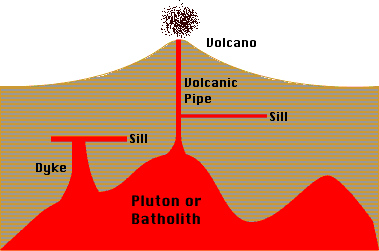
4. Use this image, the process of elimination, and your thinking cap to label your Forming Igneous Rock diagram.
With recent activity at Mount St. Helens in Washington, you can watch a great NOVA documentary about its last eruption below.
For the activities we will be doing, you will need to use the following websites:
1. Parts of a volcano.
2. Major volcanoes in the Ring of Fire.
3. Type of volcanoes. ( Once you complete the sheet, you will then model these volcanoes using your clay.)
AND Types of Volcanoes Diagrams!
4. Use this image, the process of elimination, and your thinking cap to label your Forming Igneous Rock diagram.
With recent activity at Mount St. Helens in Washington, you can watch a great NOVA documentary about its last eruption below.
Monday, April 28, 2014
DNews Monday & Plate Tectonics Homework Help
Monday news...exomoons!
Here is a World Plate Map, to help you with your homework sheets due on Wednesday. Make sure to read any information and directions on your sheets carefully. Some plates have slightly different names, so you may need to do further research or us process of elimination.


Here is a World Plate Map, to help you with your homework sheets due on Wednesday. Make sure to read any information and directions on your sheets carefully. Some plates have slightly different names, so you may need to do further research or us process of elimination.

Monday, April 7, 2014
Science News Monday, Ohm's Law, and Study Guide!
Hey, hey, hey! Today is Monday and that means DNews. It also means our test is merely days away. Remember, you may use one small note card, front and back, for the test.
DNews here and study materials below...
Below is a picture of Ohm's Law, which we will begin covering today, and the study guide.
Remember:
V=Voltage (Volts)
I=Current (Amps)
R=Resistance (Ohms)

DNews here and study materials below...
Below is a picture of Ohm's Law, which we will begin covering today, and the study guide.
Remember:
V=Voltage (Volts)
I=Current (Amps)
R=Resistance (Ohms)
Electricity and
Magnetism Study Outline
·
I know the parts of an atom.
o
Protons (positive charge) and neutrons (no
charge) in the center.
o
Electrons (negative charge) on the outside.
·
I know what electricity is and how it relates to
the parts of an atom.
o
Electricity is the flow of electrons.
o
Electrons are the parts of an atom that move
because they are on the outside of the atoms, where they already move freely.
·
I know the difference between static electricity
and current electricity.
o
Static electricity is the sudden discharge of
electrons when they come in contact with an opposite charge or another
conductor.
o
Current electricity is the constant flow of
electrons through a circuit.
·
I know how static electricity and current
electricity are formed.
o
Current electricity requires a power source,
whether it is a battery, turbine, or something else that creates a charge.
Current electricity allows electrons to flow through conductive wires, in a
closed circuit, to power a variety of different things.
o
Static electricity is created when electrons
build up in one area- usually from friction (rubbing one surface against
another) and adhesion (electrons sticking from one surface to another).
·
I know the difference between conductors and
insulators.
o
Conductors-allows electricity to flow freely.
(Ex. Metals)
o
Insulators-prevent the flow electricity. (Ex.
Rubber, Plastic)
·
I know what voltage, current, and resistance are
and how they are measured and related.
o
Voltage is the electric force that causes the
free electrons to move from one atom to another. Just like water needs pressure
to force it through a hose, electrical current needs some force to make it
flow. A volt is the measure of electric pressure. Voltage is usually supplied
by a battery or a generator. The symbol for volts is “V.”
o
Current is electricity in motion. It
measures the amount of electrons that can flow through a material like a
conductor. Electrical current is measured in amperes or "amps"
for short. Amperes is like the amount of water flowing through a hose in a
certain amount of time or the amount of electricity flowing through a wire. The
scientific symbol for amps is the letter "I".
o
Resistance controls how much current is allows to flow through the circuit. It can
be like a kink in the hose that stops or slows down the flow of water.
Resistance is measured in “ohms” and is written as “R.”
o
When I increase the resistance, I decrease the
current. When increase the voltage, I increase current.
·
I know how to use Ohm’s Law to find voltage,
current, and resistance.
o
V=I x R
o
R= V/I
o
I = V/R
·
I know how to find the resistance level of a
resistor (hint: colored bands).
o
The first color band tells you the first number
of resistance. The second colored band tells you the second number. The third
colored band tells you the number of zeroes after the first two numbers.
·
I know how to identify the different electrical
symbols in a schematic diagram.
o
See attached sheet.
·
I know the difference between a series and
parallel circuit.
o
In a series circuit, the same current flows
through all the components. They are in one continuous loop. An example of a
series circuit is a string of Christmas lights. If any one of the bulbs is
missing or burned out, no current will flow and none of the lights will go on.
Parallel circuits are like the smaller blood vessels that branch off from
an artery and then connect to a vein to return blood to the heart. Now think of
two wires, each representing an artery and a vein, with some smaller wires
connected between them. These smaller wires will have the same voltage applied
to them, but different amounts of current flowing through them depending on the
resistance of the individual wires.
An example of a parallel circuit is the wiring system of a house. A
single electric power source supplies all the lights and appliances with the
same voltage. If one of the lights burns out, current can still flow through
the rest of the lights and appliances. However, if there is a short circuit,
the voltage drops to almost zero, and the entire system goes down. Below there
is a series circuit on the left and a parallel on the right.
·
I know the difference between direct current and
alternating current.
o
With direct current, the current is always
flowing in the same direction; batteries are an excellent example of a source
of direct current.
o
With alternating current, the current is
constantly changing direction.
·
I know the two famous scientists who designed
these two types of current the late 19th and early 20th
centuries. (Tesla and Edison
·
I know how electromagnetism works.
o
Electromagnetism is using an electric circuit to
create a magnetic field. The stronger the current, the stronger the field. You
can also increase the strength by adding a solenoid, which is a wire coiled
around an iron core.
·
I know how magnets work.
o
Magnets are items that use a magnetic field (an
invisible force) to attract objects. This magnetic field is created when
magnetic domains are aligned from a north pole to a south pole in magnetized
objects. Just like with electricity, opposites attract. Like poles, just as
like charges, will repel, and opposite poles, like opposite charges, will
attract. Most magnets contain magnetite, which is a naturally occurring type of
iron ore. However, magnets can also be made from aluminum, nickel, and cobalt.
·
I know why the earth is like a magnet.
o
The inside of the earth is theorized to have
large deposits iron materials, which add to its magnetic properties. These
magnetic properties create align to create a magnetic north and south pole,
which then creates a magnetic field around the earth.
·
I know that opposite forces attract and like
forces repel in both magnetism and electricity.
·
I know the types of objects can be magnetized or
attracted to magnets, which are not, and why.
Sunday, March 30, 2014
Science News Monday, Electronic Circuits, & the Story of Electronics
Me thinks I see the JPL lab!
Electric Circuits & Symbols: Copy the symbols into your notebook!
For Tuesday watch the video below and answer the following questions on a sheet of loose leaf for a brief debate/discussion in class. There are no right or wrong answers here. It's what you think or feel!
1. What are your initial thoughts and opinions after watching this video?
2. Do you agree or disagree with its message? Why?
3. Do you think electronic waste should be the issue of the companies that make products or the people that buy them? Why?
4. If you were an electronics designer, what would you do? Why?
Monday, March 24, 2014
Science News Monday and STATIC ELECTRICITY INTRODUCTION!
Where should we start with STATIC ELECTRICITY? Well here, at Jefferson Labs, learning about ATOMS!
For tomorrow, may I introduce you to the virtual balloon and John Travoltage!
CLICK HERE for the first lab or on the picture below...

| Click to Run |

| Click to Run |
OR CLICK HERE to access John Travoltage!
When you finish, feel free to check out the other ELECTRICITY AND MAGNETISM SIMULATIONS!
Monday, March 3, 2014
Science News Monday & ELECTROMAGNETS!
DNews: Exoplanets
A tour of the ELECTROMAGNETIC SPECTRUM from Science @NASA!
Tuesday, February 18, 2014
Science News: Tuesmonday!
A day late and a dollar short...
Hey! We are talking about CME's, and the way that they interact with our MAGNETOSPHERE.
What do rockets have to do with that? How are scientists using them to study auroras? Watch the video below to learn more.
AND finally, here is a Curiosity Rover Report... I think I have seen that "scarecrow" before, and that Mars yard looks awfully familiar. Hmmmm...
Monday, February 10, 2014
Monday, January 27, 2014
Tuesday, January 21, 2014
Monday, January 13, 2014
Science News Monday
HOW BIG IS THE UNIVERSE?
Not news, but these are useful for FRIDAY'S QUIZ. Yeah, Friday. This Friday. Do you remember that?
Thursday, January 2, 2014
TO THE MOON!
Tomorrow, we will try, again, to participate in a NASA Digital Learning Network Event with the folks at Kennedy Space Center. We will be mapping the moon with WALL-E, and therefore, spending some time today and tomorrow, discussing features and characteristics of the moon.
Those of you who are creating lunar colonies for your assessment project, may find this event a useful opportunity to ask experts some question to help you complete your packet.
For tomorrow, your homework is to create your own lunar map. You may look at the moon (if the sky is clear), Google pictures of the moon, use Google Moon to help you distinguish the Apollo landing sites, or use Google Earth's "moon" option to explore a 3D moon. We will be comparing maps tomorrow!
Mrs. Loehe
Moon Map Example (You may use for your assignment.)
http://upload.wikimedia.org/wikipedia/commons/a/a1/1961_U.S.G.S._Lunar_Ray_Map_of_the_Moon_(wall_map)_-_landmark_Lunar_map%5E_-_Geographicus_-_LunarRays-usgs-1961.jpg
China on the moon!
Want to learn some more? Check out this episode of the Universe!
Those of you who are creating lunar colonies for your assessment project, may find this event a useful opportunity to ask experts some question to help you complete your packet.
For tomorrow, your homework is to create your own lunar map. You may look at the moon (if the sky is clear), Google pictures of the moon, use Google Moon to help you distinguish the Apollo landing sites, or use Google Earth's "moon" option to explore a 3D moon. We will be comparing maps tomorrow!
Mrs. Loehe
Moon Map Example (You may use for your assignment.)
http://upload.wikimedia.org/wikipedia/commons/a/a1/1961_U.S.G.S._Lunar_Ray_Map_of_the_Moon_(wall_map)_-_landmark_Lunar_map%5E_-_Geographicus_-_LunarRays-usgs-1961.jpg
China on the moon!
Want to learn some more? Check out this episode of the Universe!
Monday, December 2, 2013
Tuesday, November 19, 2013
Monday, November 18, 2013
More Science NEWS!
Well, well, well, looks like Mrs. Loehe forgot one VERY important part of science news for today: the launch of the MAVEN mission to Mars from NASA. Classes after lunch will watch this mission while working on their projects. To learn more about the MAVEN mission, click on this link!
Mrs. Loehe

_-_landmark_Lunar_map%5E_-_Geographicus_-_LunarRays-usgs-1961.jpg)
Subscribe to:
Posts (Atom)