Here is a PDF activity from the NASA.gov website that takes you through air and water recycling in space. Some of your Option Twos might find this useful...
Recycling Water and Air in Space
Showing posts with label Space Science. Show all posts
Showing posts with label Space Science. Show all posts
Friday, April 17, 2015
Wednesday, April 15, 2015
What is it like to work in space?
And more importantly what happens if you get stuck working out there? Find out from former astronaut Dave Wolf.

The SPEED of LIGHT (with Peeps)
Have you ever noticed that when you microwave something, some parts are really cold still while others are piping hot (Hate that!)? Well the distance between those hot and cold spots can help lead you to find -with a little easy math- the SPEED of LIGHT!
Yes, you read that correctly, the speed of light can be found anytime you heat up that Kid's Cuisine (Does anyone eat those anymore? Probably not, I am sure they are not even remotely natural, organic, or gluten free.) The wavelengths of the actual microwaves in a microwave go the speed of light, so if you gather a ruler, a casserole dish of food, and scrap paper or calculator, you too, can find the speed of light, using a microwave, with a little help from the video below!
Mrs. Loehe
Yes, you read that correctly, the speed of light can be found anytime you heat up that Kid's Cuisine (Does anyone eat those anymore? Probably not, I am sure they are not even remotely natural, organic, or gluten free.) The wavelengths of the actual microwaves in a microwave go the speed of light, so if you gather a ruler, a casserole dish of food, and scrap paper or calculator, you too, can find the speed of light, using a microwave, with a little help from the video below!
Mrs. Loehe
Tuesday, April 14, 2015
Monday, April 13, 2015
DNews for Monday and More on the STARS of Our Week
Happy Monday, Sixth Grade Scientists! This week, we delve deeper into the stars and the galaxies they make up. We will focus on the parts of a star (See the diagram of the Sun below.), star classification, constellations, and types of galaxies.
If you are interested in exploring what lies above our heads here in Wisconsin and elsewhere, I recommend you download the program Stellarium. It offers great, real time views of constellations and planets visible in the sky, from anywhere in the world, along with constellation lore from a variety of cultures. The best part of it all, is that it is free and available for a variety of OS platforms.
Below you will also find our DNews for Monday (It's a little old, but it answers a great question: Why is space black?) and, once again, that stellar diagram. ;)
Mrs. Loehe

If you are interested in exploring what lies above our heads here in Wisconsin and elsewhere, I recommend you download the program Stellarium. It offers great, real time views of constellations and planets visible in the sky, from anywhere in the world, along with constellation lore from a variety of cultures. The best part of it all, is that it is free and available for a variety of OS platforms.
Below you will also find our DNews for Monday (It's a little old, but it answers a great question: Why is space black?) and, once again, that stellar diagram. ;)
Mrs. Loehe
Thursday, April 9, 2015
The Sun...That Silly Star
Ah, the Sun. Provider for life and energy, giant ball of hydrogen and helium, and apparently the overlord of weather in our area of space...
Wednesday, April 8, 2015
Option Three NASA Asteroid Initiative Information
Many of you Option Three students have run into some road blocks with creating your projects. As I have still not heard back from my NASA contacts in regards to your e-mails, here are some PDFs that outline the NASA Asteroid Capture Initiative. If you would like help deconstructing what you are reading, please come and see during work time!
Mrs. Loehe
Complete Mission Overview
Asteroid Redirect Mission Reference Concept
Mrs. Loehe
Complete Mission Overview
Asteroid Redirect Mission Reference Concept
Thursday, March 26, 2015
Space Project Option Two Water Variable Concerns
This is mission control to Option Two students, come in Option Two...
Many of you who are working on designing your sustainable space colony are wondering what you can do about water in space, particularly if where you plan on settling doesn't have liquid water easily available. Well, the one this you could do, is recycle water, in all its forms, similar to what we do here on Earth and what astronauts do on the International Space Station.
Below I have included some links to help further redirect you, and once again, I urge you to look into the links on the right-hand side of the blog!
Mrs. Loehe
- Recycle dirty water using the Forward Osmosis Bag!
- Closing the Loop: Recycling Water in Space
- Singapore's Toilet to Tap Program
- Chris Hadfield on ISS Water Recycling
Thursday, March 19, 2015

Tuesday, March 17, 2015
Thursday, March 12, 2015
Solar System Review for the Quiz
Hello 6th Graders,
I originally had a Google Hangout video made to help you prepare for this quiz, but, unfortunately, the audio didn't really workout. (NOOOOOOOO!) :\ So, what I recommend you do is read the Background Information page in your scale model, NEO packet, and watch the video below!
Happy Studying,
Mrs. Loehe
I originally had a Google Hangout video made to help you prepare for this quiz, but, unfortunately, the audio didn't really workout. (NOOOOOOOO!) :\ So, what I recommend you do is read the Background Information page in your scale model, NEO packet, and watch the video below!
Happy Studying,
Mrs. Loehe
Monday, February 2, 2015
I'm baaaaaack!
Hello, Sixth Grade Scientists!
I am back, and we will start our Mondays with Science News again. Here is today's. Now that I am back, remember to check the blog regularly for resources, news, and project information!
Mrs. Loehe
I am back, and we will start our Mondays with Science News again. Here is today's. Now that I am back, remember to check the blog regularly for resources, news, and project information!
Mrs. Loehe
Wednesday, October 22, 2014
More on Rosetta...
Here are some more videos on the Rosetta mission. Remember, Philae is set to land next month!
Mrs. Loehe
Mrs. Loehe
Tuesday, October 14, 2014
My day at NASA JPL!
Greetings and salutations from Pasadena, California, Sixth Grade Scientists!
Yesterday, I spent the day visiting NASA's Jet Propulsion Laboratory for the second time. I was able to get a special look at the facility where they test futuristic engines that run on Xenon, the Mars Rover Yard, and a very famous mission control room. Later in the day, we spent time meeting with scientists and engineers who work on a variety of comet related projects launching, landing, or taking pictures of a comet near(ish) you!
You can watch the UStream of this meeting by clicking HERE, or you can view some of my tweets and pictures from the day below. I will also be creating an Animoto of all of my JPL pictures too!
Mrs. Loehe
Yesterday, I spent the day visiting NASA's Jet Propulsion Laboratory for the second time. I was able to get a special look at the facility where they test futuristic engines that run on Xenon, the Mars Rover Yard, and a very famous mission control room. Later in the day, we spent time meeting with scientists and engineers who work on a variety of comet related projects launching, landing, or taking pictures of a comet near(ish) you!
You can watch the UStream of this meeting by clicking HERE, or you can view some of my tweets and pictures from the day below. I will also be creating an Animoto of all of my JPL pictures too!
Mrs. Loehe
Art Chmieiewski shows where the Rosetta lander will touchdown on #67P @esa_rosetta @NASASocial @NASAJPL pic.twitter.com/8j5cHrxTmA
— KC Grim (@CitizenKace) October 13, 2014
This is how I picture @esa_rosetta's aperture consuming the comet's dust. #nasasocial http://t.co/6BHmtgTcNl
— Shannon Gallagher (@ShannonKarleen) October 13, 2014
Lander weighs less than a penny on the comet! WHOA! #67p #NASASocial
— Loehe Science (@BaysideScience6) October 13, 2014
#67P, the comet, is going forty times the speed of a bullet. Definitely makes it difficult for scientists on the @ESA_Rosetta. #NASASocial
— Loehe Science (@BaysideScience6) October 13, 2014
Comets: space's "icy dirtballs." #marscomet #NASASocial
— Loehe Science (@BaysideScience6) October 13, 2014
Sixth Grade Scientists, can you spot the parts of the comet? #marscomet pic.twitter.com/OqMJNuecXa
— Loehe Science (@BaysideScience6) October 13, 2014
Comet Siding Spring Mars Exploration Program: learn more, Sixth Graders! #NASASocial #MarsComet http://t.co/gqux8r7HTz via @sharethis
— Loehe Science (@BaysideScience6) October 13, 2014
How smappy is that?! It's SMAP @NASAJPL! Set to launch and circle an Earth near you! #nasasocial pic.twitter.com/NdpYEBxfr1
— Loehe Science (@BaysideScience6) October 13, 2014
Lool at the damage to @MarsCuriosity rover's wheels. Don't remember seeing that shredding last year! Rough journeys! pic.twitter.com/3cCP5YQfKT
— Loehe Science (@BaysideScience6) October 13, 2014
If I only had a brain...#scarecrow rover @NASAJPL Mars Yards pic.twitter.com/bkQutePmpR
— Loehe Science (@BaysideScience6) October 13, 2014
Xenon power! I feel like I just saw some crazy #starwars technology @NASAJPL pic.twitter.com/ZgEghQ4Dlr
— Loehe Science (@BaysideScience6) October 13, 2014
Monday, October 13, 2014
The Rosetta Mission Asks: What Can We Learn from Comets?
It's your Science News Monday Special: Speaking with Rosetta Mission Scientists about comets and their importance!
Watch the video below and visit NASA JPL's Rosetta Page (click here).
Click here for even MORE pictures, videos, and news on the Rosetta Mission via the European Space Agency's Rosetta blog.
Watch the video below and visit NASA JPL's Rosetta Page (click here).
Click here for even MORE pictures, videos, and news on the Rosetta Mission via the European Space Agency's Rosetta blog.
Tuesday, September 9, 2014
Student Aurora Questions and Answers
Today, some students asked questions about auroras to NASA scientist Jim Spann during a NASA chat. Here are a few of the questions and answers shared by the chat moderator:
jim_spann: The colors of the aurora range from deep reds to greens and occasionally blues. The colors depend on which atmospheric constituent was excited. The red ones are dominated by oxygen and the green ones by molecular nitrogen.
jim_spann: This is a great question. There are two points I would make with regard to the impact of auroras on technology. I want to introduce the concept of space weather. The aurora is our most obvious manifestation of space weather. Space weather is the dynamic aspect of the plasma that occupies space above our atmosphere. The aurora results from space weather that is driven by the variability of our star, called the Sun. Space weather can cause spacecraft to malfunction or become disabled. This impacts a lot of technology, in particular communications. So that is the first point I would make about the aurora or space weather impacting technology on Earth. The second point is that when there are large space weather events called magnetic storms, the aurora kicks up and becomes very active and very bright. Another consequence of a magnetic storm is that the currents that are created by the charged particles that cause the aurora induce other currents along our power lines and pipelines. These currents in the powerlines can cause failures to power transformers on the power grid. An example occurred in 1986 in Quebec that took out the power to millions of people in the Northeast. If we were to have a huge magnetic storm, much larger than we've experienced recently, significant damage to society's infrastructure could occur.
Are there auroras on Mars?
jim_spann: There are two things that are required for auroras. One is a magnetic field and the other is an atmosphere. Mars has an atmosphere, but a very, very weak, disorganized magnetic field. Therefore, you would not see an aurora at Mars. But you would see the atmosphere glow if you had good enough sensitivity. In fact, a NASA mission called MAVEN is arriving at Mars and will observe the Mars air glow. *
(*It should be noted that Jim Spann brought up auroras have been captured by the Hubble telescope and Cassini mission elsewhere in the Solar System! However, a planet without an atmosphere will not have auroras.)
What colors can auroras be? What causes the color change?
jim_spann: The colors of the aurora range from deep reds to greens and occasionally blues. The colors depend on which atmospheric constituent was excited. The red ones are dominated by oxygen and the green ones by molecular nitrogen.
How can auroras impact technology here on Earth? Do they have any impact on living things?
jim_spann: This is a great question. There are two points I would make with regard to the impact of auroras on technology. I want to introduce the concept of space weather. The aurora is our most obvious manifestation of space weather. Space weather is the dynamic aspect of the plasma that occupies space above our atmosphere. The aurora results from space weather that is driven by the variability of our star, called the Sun. Space weather can cause spacecraft to malfunction or become disabled. This impacts a lot of technology, in particular communications. So that is the first point I would make about the aurora or space weather impacting technology on Earth. The second point is that when there are large space weather events called magnetic storms, the aurora kicks up and becomes very active and very bright. Another consequence of a magnetic storm is that the currents that are created by the charged particles that cause the aurora induce other currents along our power lines and pipelines. These currents in the powerlines can cause failures to power transformers on the power grid. An example occurred in 1986 in Quebec that took out the power to millions of people in the Northeast. If we were to have a huge magnetic storm, much larger than we've experienced recently, significant damage to society's infrastructure could occur.
Are there auroras on Mars?
jim_spann: There are two things that are required for auroras. One is a magnetic field and the other is an atmosphere. Mars has an atmosphere, but a very, very weak, disorganized magnetic field. Therefore, you would not see an aurora at Mars. But you would see the atmosphere glow if you had good enough sensitivity. In fact, a NASA mission called MAVEN is arriving at Mars and will observe the Mars air glow. *
(*It should be noted that Jim Spann brought up auroras have been captured by the Hubble telescope and Cassini mission elsewhere in the Solar System! However, a planet without an atmosphere will not have auroras.)
Done with your vocabulary packet?
If you have finished your vocabulary packet and need something to do in class today, then please formulate some questions to share with NASA scientist, Jim Spann, about auroras! NASA is hosting a chat this afternoon, September 9th, to answer your questions about those beautiful lights in the sky. To learn more about auroras and the chat, explore the links below. Submit your questions to me before you leave class today!
Happy clicking!
Mrs. Loehe
NASA Chat: Aurora Season
What is an aurora?
What are the northern lights?
Happy clicking!
Mrs. Loehe
NASA Chat: Aurora Season
What is an aurora?
What are the northern lights?
Wednesday, February 19, 2014
Solar Wind Reading Glossary
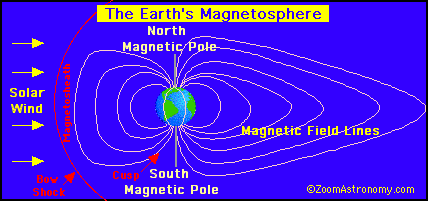
Just in case you missed something in class, here is the chart. Please make sure these are all in your notebook by Friday! -Mrs. Loehe
Word |
"Real Definition" |
| Sunspot | A cooler, dark spot on the sun that shows a concentration of magnetic forces. |
| Sunspot Cycle | The 11 year (on average) cycle of sunspot increases and decreases. |
| Solar Flares | A powerful release of energy from the sun's surface (like 1000 hydrogen bombs) where magnetic fields were tangled. |
| CME (Coronal Mass Ejection) | The sudden explosion of matter from the surface of the sun. |
| Corona | The outer layer of the sun that extends into interplanetary space (seen during eclipses). |
| Magnetosphere | The protective, magnetic region around the Earth that controls charged particles. |
| Bow Shock | The protective magnetic boundary on the Sun-side of the Earth. |
| Magnetotail | The magnetic boundary stretching behind the Earth (like a tail). |
| Aurora Borealis & Aurora Australis | The Northern and Southern Lights, which are curtains of light on the magnetic poles caused by charged electrons interacting with the atmosphere. |
| Auroral Oval | A glowing donut shape over the magnetic poles |
| Magnetic Sub-Storms | Storms that occur when the magnetic field around earth is changed because of a switch in the solar winds' polarity. |
| Auroral Storm | Magnetic storm auroras. |
| Geomagnetic Storms | Sever magnetic storms that are caused by major changes in direction and density of solar winds. |
Tuesday, February 18, 2014
Science News: Tuesmonday!
A day late and a dollar short...
Hey! We are talking about CME's, and the way that they interact with our MAGNETOSPHERE.
What do rockets have to do with that? How are scientists using them to study auroras? Watch the video below to learn more.
AND finally, here is a Curiosity Rover Report... I think I have seen that "scarecrow" before, and that Mars yard looks awfully familiar. Hmmmm...
Wednesday, February 12, 2014
Galaxy Types (and other quiz related matters)
Here is the transparency from last week's class!
Here is Edwin Hubble's Fork Diagram.
What else to know for the quiz...

Here is Edwin Hubble's Fork Diagram.

What else to know for the quiz...
- What type of galaxy are we in?
- How are the phases of the moon created?
- What is an "umbra" and a "penumbra?"
- Why don't we see more eclipses?
- Why are there tides?
- What is a magnetosphere? (We will talk about this tomorrow!)
Subscribe to:
Posts (Atom)