Showing posts with label Class Activities and Homework. Show all posts

Thursday, September 11, 2014

Oreo Lab Today!

HELLOOOOOO!

Today we begin our Oreo Lab, in which we put our newly learned science terms to use; investigate proper collection of data; look at variables; and discuss proper lab writing. Since this is our first official lab of the year, please remember the rules of the lab as discussed in class. Make sure to be safe and respectful of me, each other, the classroom, and the materials you are using. Wear your goggles, and stay with your team! Finally, EVERYONE MUST HELP CLEAN UP THEIR SPACE ONCE THE LAB IS COMPLETED!

The jobs that we have during lab time (Some of you may have to double up.) are summarized below. You each are responsible for filling out your own lab packet and must label all data collected. Remember you can find a copy of the lab on Google Classroom to print off if you lose your lab between today and tomorrow. 

Happy dunking!

Mrs. Loehe

Lab Roles 

  • The "reporter" is in charge of reporting what the group has done. The "reporter" needs to ask the following questions: 
    • "Did everyone have a chance to speak?"
    • "Did we listen to everyone?" 
    • "Did I report what the group wanted me to say (or just what I wanted to say)?”
  • The "getter" is in charge of picking up materials and making sure that the group works safely. The "getter" needs to ask the following questions: 
    • "Did everyone follow the safety rules?”
    • "Did everyone share?"
  • The "starter" is in charge of handing out materials and helping all members of the group. The "starter" needs to ask the following questions:
    • "Did everyone do the task?”
    • "Did everyone get the help they needed?”
  • The "recorder" is in charge of writing down or recording what the group discovers. The "recorder" needs to ask the following questions:
    • "Did everyone give their ideas?" 
    • "Did I write down everyone's ideas?"

Wednesday, September 3, 2014

Unit One: Science and Engineering Packet Resources

Here are resources to help you complete your packet for next Wednesday, September 10.

Richard Feynman's The Value of Science Reading

Brain Pop: The Scientific Method

The Reeko Science Glossary

Britannica Kids

World of Science Dictionary

Or you have that Google thing...happy searching.

Mrs. Loehe

P.S. If you can't get into Google Classroom or lost your hard copy, here is one you can copy, paste, and print...

NAME___________________________


So what is science?
What about that engineering thing? Why are they important?
What the heck are all these words?


These are all legitimate questions, and it is important to have a good idea about the answers to them as we move forward with our school year. Before we begin the processes of science and engineering we need to understand how they work and what terms you will be coming across throughout the year.


Below is a list of common science and engineering terms you should know to be successful this year. Before you start looking up definitions though, I would like you to look at the list of terms below and generate some questions about them. Discuss and share your questions with your team members. Then, organize the terms into three, word categories: science, engineering, and both. Divide and conquer these words at your table, look up and write down the definitions for each of these words. Finally, share out with the class what you have learned next Monday!


Models Variables Controls Materials Evidence Phenomena Theory Revisions Observations Accuracy Laws Experiment
Hypothesis Measurement Data Solutions
Problems Questions Conclusions Constraints
Criteria Design Outliers Process/Procedure


What questions come to mind when you look at these words? (Other than, “What are these words?” OR “Why are we doing this?”)


Now organize the terms into these three groups. Which do you think are science terms? Which do you think are engineering terms? Which do you think could be both?


Science
Both
Engineering


Discuss your reasoning for how you organized the words with your table and classmates. Once you have done this, divide and conquer the words! You do not need to find the definitions of ALL of the words, but you do need to have all of the definitions -either written or through drawing- in the table below to receive full credit.
Word
Definition
Models

Variables

Controls

Evidence

Phenomena

Theory

Law

Revisions

Observations

Questions

Problems

Hypothesis

Experiment

Process/
Procedure

Data

Conclusions

Solutions

Criteria

Designs

Constraints

Criteria

Outliers

Accuracy

Measurement

Materials


Sunday, August 31, 2014

Welcome Back! Here is your '14-'15 syllabus...

WELCOME 6th GRADERS
Greetings and salutations, YOUNG SCIENTISTS!

I am Mrs. Loehe (formerly Miss S),  and this year, will be filled with observations, explorations, and discovery! You will learn about the world and universe around us through a variety of different resources and labs. The goal of this class is for you to learn and have fun in the WORLD AND SCIENCE. Below is an outline of what we will be learning this year, along with some frequently asked questions and answers.

Stay Inquisitive,
Mrs. Loehe

How do you pronounce your name?
It is pronounced lay, like the potato chips. I am also fine with "Mrs. L."

What are we covering in this class?
This year's units are as follows:
  • Scientific Inquiry: How does science work? What do scientists do to explore the world around us and solve problems?
  • Matter: What is matter and why does it matter? What is mass, volume, and density? What tools do we use in science for measuring matter?
  • Scientist, Inventors, and Careers: How has science shaped the world? Who are the scientists/inventors that have helped shape it?
  • Electricity and Magnetism: What is energy? What is a force? How are energy and forces created? How can we create it?
  • Astronomy: SPPPPAAAACCCCE! What is this universe we are in? How was it formed? What else is lurking in it? Where is space exploration taking us now? Where has it been?
  • Earth Science: What is going on in this planet of ours? How is put together? What is its history and how does that affect us today?

What cool stuff are we going to do?
Some labs and activities you will do this year include:
  • Write a Science Experiment
  • CSI, Science Measurement Lab
  • Floating and Sinking Clay Lab
  • Scientist and Inventor Wax Museum
  • Build Your Own Space Colony
  • Earth Investigation Projects (Cartoons, YouTube Videos, Presentations, Websites)
  • Rock Labs
  • Chat/Tweet Sessions with Museums, Scientists, Labs, or NASA
  • Circuit Board and Electronic Creations

How will we be graded?
Below is a breakdown of the grades. The weight of tests, quizzes, homework, or projects/labs assigned within each of the assessment areas will be different depending on the size and expectations of the assessment. For example, a large, summative test may have a weight of 1.00 in the grade book, but a small quiz may only have a weight of .25. You will have opportunities to redo all assessments for full credit, to better demonstrate your understanding, with parent/guardian sign off and within a set amount of time.
  • Summative Assessments (BIG Labs, Long-term Projects, Tests, Quizzes): 50%
  • Formative Assessments (Homework, Small Labs, In-Class Projects and Activities): 40%
  • Science Starters: 10%

What do I need for class?
Here are useful items you should always bring to class:
  • 1.5" Binder with dividers
  • Notebook (put that in your binder)
  • Writing Utensils
Sometimes we need scissors, coloring utensils, calculator, a metric ruler, tape, and/or glue too. ALWAYS CHECK THE DOOR! :D

What are Science Starters?
Everyday (mostly) there will be a science-related questions or problems for you to solve. You will be given new "Science Starter" sheets every four weeks, where you will put you answers. I will go around and check off that you have attempted to collaborate with your table mates to solve the problems and recorded your answers. You will not be graded on whether you got them right or wrong but rather if you have completed the Science Starters for the week (one point per day).

What are the expectations in our science lab?
Be safe and respectful to everyone and everything in the classroom. Be accountable for all of your actions and accept all consequences, good or bad. We will brainstorm some more ideas and create a contract for you to sign!

What if I need help, or I was not able to finish my homework?
You can always find me during study halls and after school, so come in and ask if you need help with an assignment. You can also e-mail me at jloehe@foxbay.k12.wi.us or in Google Classroom. You can also find A LOT of great resources on my science blog or in Google Classroom as well. We will be setting up your Google Classroom account in the first weeks of school.

It is your responsibility to do this and nobody else's! If you are unable to complete your homework, but have attempted it, have a parent or guardian write me a note or e-mail. Otherwise, late homework is unacceptable and points will be deducted from assignments (from the grade earned) each day they are late. Homework that never makes it to me will be marked as missing in the portal and receive no credit. In the case of three late assignments, you will receive a tenth hour, in order to stay after school to play “catch up” on your late work.

Will you have pets?
A virtual one! Check out our hot pink, hedgehog, Eratosthenes (right side of the blog page). Named for the Greek scientist who first, and very closely, found the Earth's circumference!

Not satisfied? Here are some pictures of my dogs, Zuku and Nita, dressed their best...
Zuku (Shiba Inu)

Nita (Spanador)

Wednesday, June 4, 2014

Year in Review

Dearest Sixth Grade Scientists,

Enjoy this video highlighting all of the fun we had in sixth grade science this year!

Mrs. Loehe


Monday, May 12, 2014

The ROCKIN' Rock Cycle

Happy Monday, sixth grade scientists! This week will be focusing on rocks, the rock cycle, and geological time in order to prepare for next week's fossil dig. After DNews, you and an you're team members will investigate the three types of rocks (Igneous, Metamorphic, and Sedimentary), and the cycle they go through on and within the earth.

You will find the instructions for today's activity below. Good luck!

Mrs. Loehe

P.S. Did anyone watch Cosmos last night? Yet again, it all looks very familiar. Hmmmm... What class have you heard that information in before? ;)

DNews (It's from last year, but, meh, it's about volcanoes, lightning, and stuff...)


WHAT AM I DOING TODAY, MRS LOEHE?!?!?!

Step One: DO NOT PANIC!

Step Two: Open up the books at your table to page 42. You will have to share. Sorry.

Step Three: Read pages 42-45. Look for the terms Igneous, Metamorphic, and Sedimentary. Write their definitions and some example of each rock in your notebook. YOU ONLY NEED THE DEFINITIONS FOR THE THREE TYPES OF ROCK, YOU DO NOT NEED THE DESCRIPTIONS OF THE EXAMPLES. ONLY LIST THEM!

Step Four: Use an iPad or another device to find a diagram of the Rock Cycle. Draw, label, AND color your own awesome diagram in your notebook or on a separate sheet of paper. Below is an example done on Google Draw by one of last year's sixth graders. If you have your own device, feel free to Google Draw your diagram.


Step Five: Show Mrs. Loehe your handiwork by TOMORROW! (Yes, if you don't get it done, it IS homework.) If you finish in class you may visit this INTERACTIVE ROCK CYCLE website, play Landform Detective, use the virtual plate tectonics lab, or quietly work on other homework.

Step Six: SUCCESS!


Thursday, May 8, 2014

Volcanoes: They're Explosive! (Well some are...)

Today and tomorrow we will be focusing on volcanoes. We will be looking at the types of volcanoes, the Ring of Fire, how volcanoes shape the Earth's surface, and are part of the rock cycle (We'll learn more about that next week.).

For the activities we will be doing, you will need to use the following websites:

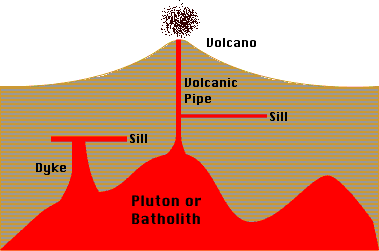
1. Parts of a volcano.

2. Major volcanoes in the Ring of Fire.

3. Type of volcanoes. ( Once you complete the sheet, you will then model these volcanoes using your clay.)

AND Types of Volcanoes Diagrams!

4. Use this image, the process of elimination, and your thinking cap to label your Forming Igneous Rock diagram.

With recent activity at Mount St. Helens in Washington, you can watch a great NOVA documentary about its last eruption below.


Tuesday, May 6, 2014

Earthquake Notes for Friday's Quiz

These are notes you should put in your notebook for studying! I will check for them on Thursday before the quiz on FRIDAY (5/9). -Mrs. Loehe

Epicenter- The point of an earthquake on the Earth's surface, directly above the interior, where earthquake energy is released.

Primary (P) Wave- A P wave, or compressional wave, is a seismic body wave that shakes the ground back and forth in the same direction and the opposite direction as the direction the wave is moving. (Like a slinky.)

Secondary (S) Wave- An S wave, or shear wave, is a seismic body wave that shakes the ground back and forth perpendicular to the direction the wave is moving. (Like a wave in a pool.)


Fault- A fault is a fracture along which the blocks of crust on either side have moved relative to one another parallel to the fracture.

fault
Tsunami- A tsunami is a sea wave of local or distant origin that results from large-scale seafloor displacements associated with large earthquakes, major submarine slides, or exploding volcanic islands. 
tsunami

Subduction Zone- The subduction zone is the place where two lithospheric plates come together, one riding over the other. Most volcanoes on land occur parallel to and inland from the boundary between the two plates.

subduction zone

Ring of Fire- The "Ring of Fire", also called the Circum-Pacific belt, is the zone of earthquakes surrounding the Pacific Ocean- about 90% of the world's earthquakes occur there. The next most seismic region (5-6% of earthquakes) is the Alpide belt (extends from Mediterranean region, eastward through Turkey, Iran, and northern India.
Ring of Fire


Friday, May 2, 2014

Monday: Earthquake Virtual Lab Links

Earthquake Links:


Earthquake Challenge Link:
Plate Tectonics Simulation (Just for fun and because you asked!):

Plate Tectonics
Click to Run

Wednesday, April 30, 2014

Plate Tectonics Packet Resource

On page three of the plate tectonics packet from yesterday, you need to use a physical map of Oregon to answer question two. Look for the two mountain ranges at the coast!

Monday, April 28, 2014

DNews Monday & Plate Tectonics Homework Help

Monday news...exomoons!

Here is a World Plate Map, to help you with your homework sheets due on Wednesday. Make sure to read any information and directions on your sheets carefully. Some plates have slightly different names, so you may need to do further research or us process of elimination.


Wednesday, April 23, 2014

How to do your Layers of the Earth Foldable...

Here are several step by step direction options, and an example, to help you do this project successfully by Friday, 4/25.

Example:


Step by Step Tutorial Video CLICK HERE

A YouTube tutorial on how to do this too. MAKE SURE TO COLOR YOUR LAYERS FIRST!